
Sauna After Every Workout: Is It Worth It?
Disclosure: This post contains affiliate links. As an Amazon Associate, I earn from qualifying purchases at no extra cost to you.
For a long time I avoided the sauna entirely. It felt like something other people did — older people, people with more time, people who were already done with the hard part of getting fit. Not part of my routine. Today it is one of the things I never skip after training. Not because I have to, but because I feel a real difference. And the reasons I kept going back turned out to have very little to do with what I originally expected.
How the Routine Actually Looks
After training I fill my shaker with water and protein powder straight away and drink it on the way to the changing room. No time wasted. Then I head directly to the wellness area.
The first stop is the Solenbecken — a salt water pool. I spend five to ten minutes there before anything else. The salt water is noticeably denser than a regular pool and there is something about the combination of warmth and buoyancy that helps the muscles start to unwind after a hard session. From there I go straight into the sauna.
On a regular evening I do about ten minutes in the sauna on my own. But whenever there is a sauna session running, I stay for the full thing — usually eight to twelve minutes. At my gym these sessions happen every hour in a larger sauna. There is someone running the whole thing who controls the temperature and adds essential oils, typically three types: lemon, lime, orange. You can feel the oils on your skin long after you leave the room. Some sessions are hotter and more intense. Others are quieter and closer to a wellness experience — the person running it rings a small bell, the kind you associate with meditation, and the whole thing becomes less about the heat and more about switching your head off completely. That version is harder to describe but easier to feel.
Why I Actually Started Going
I did not start going to the sauna because I had read about post-workout recovery. I started because I had two problems that had been bothering me for years and I was looking for something that might help.
The first was hypertension. I had been diagnosed by a doctor and I was paying attention to it. I measured my blood pressure regularly at home. I had also been to check my thyroid because I wanted to rule out underlying causes. Everything came back normal, it was just how my body was running at the time.
Alongside the sauna, I also started taking omega-3 and magnesium regularly around this time. I use WeightWorld Omega 3 (link) and WeightWorld Magnesium Glycinate (link) — both straightforward, both something I have kept in my routine for over a year without second-guessing.
The second was excessive sweating. In summer it was bad enough that sweat would drip into my eyes just from walking through the city. Not from exercise, just from being outside. I had looked into it, spoken to doctors, checked everything I could think of. Nothing was wrong. It was just my physiology.
My thinking when I started going to the sauna was fairly straightforward: if I expose my body to extreme heat regularly, both in summer and in winter, maybe it adapts. Maybe the system that regulates temperature learns to work more efficiently when it is being trained the same way muscles are trained — through repeated exposure to stress. I had no proof that this would work. It was more of an instinct than a strategy.
What Changed Over Time
The sweating improved noticeably. I still sweat — that is never going to disappear completely — but the severity that used to embarrass me in public is not there anymore. My body learned to handle heat differently. Whether the sauna is the main reason or just part of a bigger picture that includes training and diet, I cannot say with certainty. But the timing lines up.
The blood pressure story is similar. Doctors who previously told me I had hypertension now measure it and tell me everything looks fine. I hear that regularly enough that it is hard to dismiss. I am not saying the sauna fixed it. I also changed my diet, started training seriously, and cut out energy drinks for nearly two years. All of those things matter. But the sauna is part of what I have been doing consistently, and something in the combination clearly worked.
There is research that supports this. A Finnish study published in JAMA Internal Medicine in 2015 followed 2315 men over nearly 21 years. The findings were clear: the more frequently someone used the sauna, the lower their risk of sudden cardiac death, fatal cardiovascular disease, and all-cause mortality. Men who used the sauna four to seven times per week had a 63 percent lower risk of sudden cardiac death compared to those who went once a week. The researchers also noted that regular sauna use lowers blood pressure and improves left ventricular function, particularly in people with hypertension. That kind of evidence does not prove that sauna alone solves anything, but it does suggest it is not a trivial habit either.
Source: Laukkanen, J.A. et al. (2015). Association Between Sauna Bathing and Fatal Cardiovascular and All-Cause Mortality Events. JAMA Internal Medicine, 175(4), 542–548. https://jamanetwork.com/journals/jamainternalmedicine/fullarticle/2130724
The Part Nobody Talks About
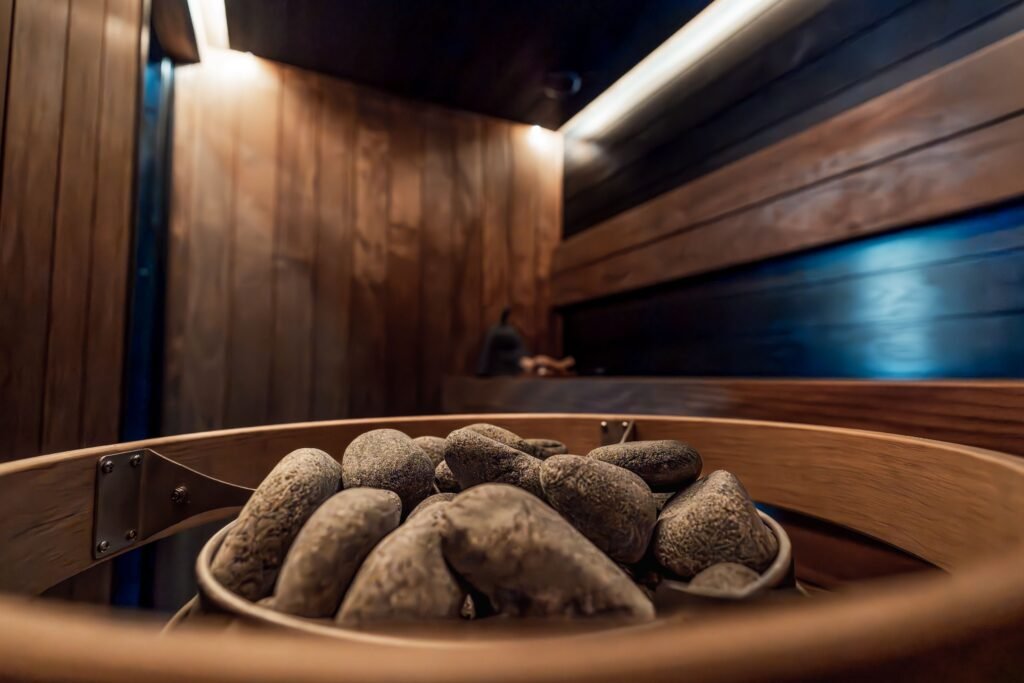
Everything above is the practical side. But honestly, the reason the sauna became a fixed part of my routine is not physiological. It is that it became the one point in my day where I completely disconnect.
No phone. No noise from work or anything else. Eight to twelve minutes where nothing is required of me except to sit and breathe. After a training session where I have been pushing my body as hard as it will go, that transition into stillness feels like something the body was asking for. The oils in the air, the heat, the quiet — especially on the meditation-style sessions with the bell — it all creates a kind of environment that is difficult to recreate anywhere else.
I started looking at the sauna less as a recovery tool and more as a ritual. Something I genuinely earned after putting in the work. It makes the whole evening at the gym feel like a complete experience rather than just another thing to tick off. That shift in how it feels is probably the main reason I have not skipped it.
The effect of temperature on recovery is something I looked into separately after noticing how differently my body responded to warm versus cold water after training. If you want to understand why a cold shower after a strength session works against you rather than for you, I covered that in detail in Why I Stopped Doing Cold Showers After Training.
A Few Rules I Follow
I always sit on a towel. I drink water before going in and again after coming out — the sauna dehydrates you more than it seems, and if you do not replace the fluids you feel the difference the next day. I shower before entering and after leaving. After the final session I step outside for a few minutes to let my body temperature come back down before getting dressed.
None of this is complicated. It just requires treating the sauna like it deserves a small amount of preparation, the same way you would not walk into a training session completely cold.
Is It Worth It?
For me, without any doubt. The improvements in my blood pressure and sweating alone would have been enough justification. The way it fits into the end of a training session as a deliberate wind-down makes the whole habit feel sustainable rather than obligatory.
My gym has five different saunas, which makes variety easy. But you do not need that. One sauna, ten minutes, a bottle of water — that is enough to start with. If your gym has a sauna and you have been skipping it, give it a consistent month. You might find, the way I did, that eventually you no longer want to go without it.
If you are still building the habit of getting to the gym consistently in the first place, the structure I use is covered in How I Finally Stopped Quitting the Gym. The sauna works best as a reward at the end of a session you actually showed up for.
The content on this blog is based on my personal experience and does not constitute medical, nutritional, or fitness advice. Always consult a qualified doctor or professional before making changes to your training, nutrition, or lifestyle.